
Let Justice Roll Down
What Scripture Prescribes for a Unified Church

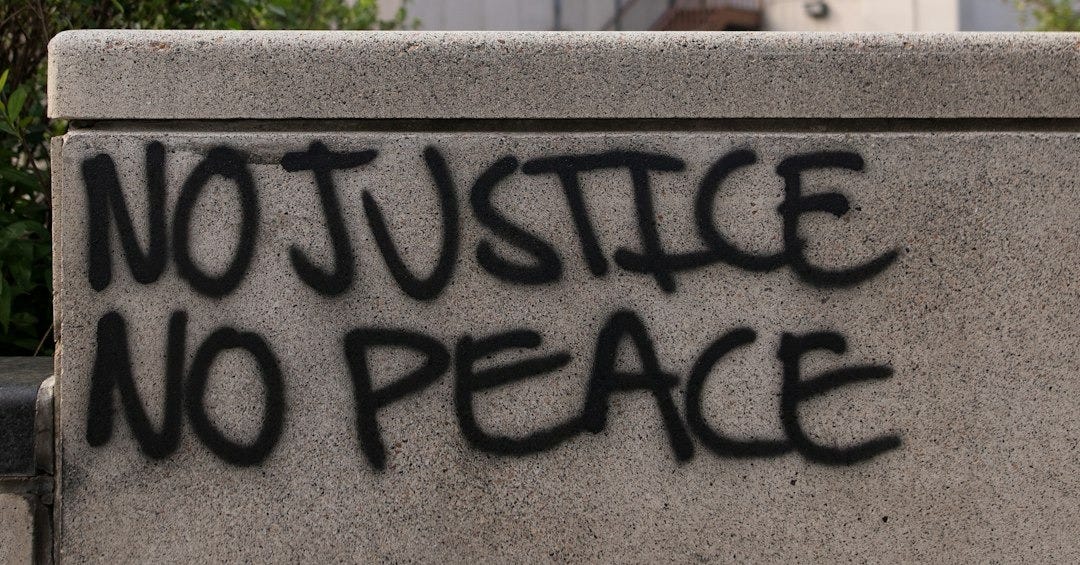
“I don’t hate America, I just demand she keeps her promises.”
—Propaganda aka Jason Petty
“Jesus was a bridge builder, but you can’t build a bridge from the middle. You have to pick a side and Jesus always started on the side of the powerless.”
—Richard Rohr
Disclaimer-ish
Maybe I’m in my head, but my past experiences tell me that this post won’t be enough for my progressive friends. And at the same time, it will be too much for my conservative friends. And yes, I do have both. While I normally write a place of lived experience, reflection, and opinion, this will be different. I’m doing my best to withhold any judgements, or assign value to a particular world view, and instead let scripture speak for itself in context.
Also, I’m not a theologian. I’m not a biblical scholar. However, I have a library card, Hoopla account, Audible (I know, I know) and access to the internet and AI research apps. So do you. The point is I’m not asking you simply agree. That’s lazy and doesn’t produce any real transformation. I’m asking you to wonder. To be curious. To ask what would our world look like if this was true and we actually did it? Would it be better? If so, for whom? Could it get worse? If so, for whom?
Okay…here we go.
Powder Keg
On the morning of January 26th Alex Pretti was shot and killed by a Federal ICE agent while aiding a woman who had been shoved by the agents. This came just 17 days after an ICE agent shot and killed Renèe Good. 32 people died in ICE custody in 2025, marking it as ICE’s deadliest year in the past two decades. Emotions were understandably high and per usual, not everyone agreed on what was right, or what was wrong.
Over the next 48 hours varying statements were made by American clergy. Close to 100 clergy members were arrested for protesting ICE at the Minneapolis-St. Paul International Airport. Others released statements calling for justice. Some stayed silent.
And others, sensing the growing division among Christians in the US, called for unity.
I want to be clear: I don’t think most people reaching for unity are doing so maliciously. Many genuinely believe they’re following scripture. People are scared—scared of division, scared of losing community, scared that the conflict itself is the problem. And so they reach for Proverbs 6:19, which lists among the things the Lord hates “one who sows discord among brothers.”
In fact, this past Sunday, a popular church preached exactly this—a sermon on unity, citing Proverbs 6:19 about sowing discord. But here's what they didn't mention: verses 16-18. The six behaviors that cause the discord in the first place.
It feels right. It feels faithful. It’s truth to stand on. Someone needs to call for peace, right?
But here’s where we need to slow down and look at the text in its context first and see how it lines up with our current reality.
Context
A bulk of the Proverbs were penned in 8th-6th centuries and scholars generally agree that the first nine chapters were penned last. This matters because by this time the Kingdom of Israel had already been conquered by Babylon and sent into exile. Babylon was then conquered by Persia, who allowed Israel to return to its land.
The prophet Jeremiah had warned them early on that their lack of care for the poor and the foreigner would be their downfall (JER 5:26-29, JER 7:5-7, JER 22:13-17 & JER 34 all of it) and he was spot on.
Jerusalem was destroyed. Their temple burned to the ground. These authors weren’t writing from a position of power, but from the view point of people given another chance and starting from scratch. Their literature and traditions remembered the good ol’ days of David and Solomon—of riches and influence. But those days were long gone. Now they were starting with less than zero.
Persia gave them permission to return, but they had no political independence. They were a colonized people once again. They were impoverished—literally struggling to survive. They had no military. They had their Torah, their covenant with God, and another chance. That was it.
Proverbs chapter six serves as a warning for future generations. A warning that says we were instructed.
We didn’t listen.
We paid the price.
The nation fell.
Don’t repeat our mistakes.
Autopsy of a Nation
So what were the mistakes? In verses 16-19, they name them. In fact, they highlight them with a poetic pattern. The “there are six things that the Lord hates, even seven things that are an abomination to Him” calls the reader to pay special attention to what follows. This isn't 'God's pet peeves' as much as it's a blueprint to societal collapse. These seven behaviors systematically erode trust, and trust is what holds any community together. These are the patterns their own leaders adopted. The patterns that destroyed them. They're essentially saying: 'We saw this. We lived it. Here's the anatomy of how nations die.
One final note before we get into it. This was the law of the land, not just the tribe. Meaning, this is how Israel suggested they treat everyone who lived there, not only their tribe. This meant Canaanites, who worshipped entirely different Gods, including Baal. It included Assyrians and Babylonians, both of whom had oppressed, murdered, and exploited God’s people.
Keep that in mind.
Haughty Eyes
The word for haughty here is rûm and it means to raise, or exalt oneself. Eyes are what you see with, unless you’re an ant or bat. So, the first step to ruin is to see others as beneath you.
Pause for a moment and let that sink in. It makes no reference to how you treat someone. This is about how you see someone—specifically, those you deem less than you. This isn’t about being nice. You can be polite while still devaluing someone’s worth.
The eyes matter because you don’t exploit people unless you first see them as inferior, disposable, obstacles to overcome, or tools to use. And once you get the wrong view of a person or people group oppression, injustice, classism, and exclusion aren’t far behind.
A Lying Tongue
As a parent, we give our children three rules to remember. Don’t lie. Do what you say you’re going to do. Don’t do what we’ve told you not to do. It’s really just one rule. Don’t lie with your words or your actions. Inevitably when those rules are broken and we sit down to have the conversation we ask two questions. Which rule did you break and why does it matter? The answer to the first question varies, but the answer to the second question is always the same.
It matters because lies break trust and a break in trust fractures relationship…and relationships are the most important thing in a family.
If that's true for five people living under one roof, imagine how critical it is for an entire community trying to survive together.
The same was true in the ancient east, but even more so. They didn’t have terms and conditions, contracts, or specialized lawyers to keep everyone accountable. They had their word and it was sacred.
Once you begin to view someone as beneath you, it makes it easier to justify not living up to your end of the bargain, or simply saying things about them that you believe to be true, but aren’t. Not all lies are intentional. A lie believed to be true is still a lie.
And when it’s told over and over again, people of an already vulnerable community are made all the more vulnerable.
Hands That Shed Innocent Blood
In Hebrew tradition the term “innocent blood” usually refers to those without power, or protection—the poor, the widow, the orphan, and the foreigner. They had no advocates which made them particularly vulnerable to exploitation.
You see this in 1 Kings in the story of Naboth. He owns a tiny vineyard that had been in his family for generations. But King Ahab wants it. When Naboth refuses to sell, Jezebel—who views Naboth as below her and the King—lies about Naboth, and in turn he is executed and his land ceased.
Sometime blood shedding is quieter…slow and indirect. It’s what happens when workers are seen as commodities and not humans. It’s when people are treated as stock and not image bearers. And none of it is possible without the very first step…seeing ourselves as above someone else.
From there we create a narrative—a lie—that justifies whatever we choose to do at the expense of those “beneath us.”
A Heart That Devises Wicked Plans
Once again, our author is using poetic imagery that gets a bit lost in our translation. The word we’re translating as devise is hāraš and it’s not simply planning or imagining. It’s more literal meaning is to cut in, plough, or engrave. The division of the community is literally baked into the word. This is a heart that is now being formed—discipled even— by haughty eyes, lying tongues, and shedding innocent blood.
This heart sees the opportunities to exploit the vulnerable, and begins to organize their worldview around the idea that they are exceptional, set apart, more deserving than others. They’ll create systems that benefit them at the expense of others.
Some modern examples could be private equity firms that buy up affordable housing complexes, raise rents beyond what residents can pay, then profit from evictions and government subsidies. The cruelty isn't accidental—it's strategy engineered into the business model.
Or, designing immigration detention systems where private companies profit per bed filled per night, creating financial incentives to keep people locked up longer. Human suffering becomes a revenue stream.
This is organized and intentional harm for profit and the origin of empire. If you’re unfamiliar with this term check out this resource from our friends at BEMA Discipleship.
Feet That are Swift to Run to Evil
The thing about plans is they generally need multiple people to execute. The feet that are swift to run to evil belong to those who enthusiastically embrace the systems that exploit the vulnerable.
And once others join in, the die is cast. The train has left the station and the work to undo what’s been done becomes infinitely harder. Empire is fully functional, but we call it something else.
The way things are.
How it’s always been.
Culture.
Law and Order.
And, to some extent…we’re all guilty.
A False Witness Who Pours Out Lies
False witness isn’t telling your boss you were late because there was a wreck on your way to work when in actuality you stayed up too late watching TikTok videos and overslept. That’s a lying tongue.
This is legal language. Court looked different back then. It took place at the city gates with elders of the community serving overseeing the matter. Law wasn’t a profession at this time. Nobody was a professional. And trust was key. Truth was considered sacred. If you lied in court you brought shame upon your entire family because you compromised the system the community relied on for justice.
This is the kill shot in our autopsy report. Because once people lose faith in the systems, the institutions—like government and religion—the ones who are supposed to right the wrongs then mistrust becomes the default. Dog eat dog becomes the norm.
A Person Who Spreads Discord Among Family Members
Cards on the table, I generally prefer the NET translation, but it doesn’t quite do justice with this verse. The MSG paraphrase is “a trouble maker in the family.” The word translated for family is ‘āh, meaning brother, relative, kinship, or same tribe.
Remember this is their rule book for building back their community, so it seems safe to assume the tribe definition fits best here. This brings us full circle. How do you spread discord among your tribe?
See the first six steps.
So when we call for unity citing verse 19 without naming the haughty eyes, the lies, the innocent blood, the systems designed to exploit, the enthusiastic participants, and the false witness that created the discord we might intend to call for biblical unity—but we’re not. We’re protecting empire. We’re asking the vulnerable to make peace with their oppressors.
That’s not peacemaking. That’s the discord Proverbs warns against.
Once trust collapses, justice collapses. Once justice collapses, peace is impossible. When peace is impossible, there can be no unity. We have to address the injustices.
Why This Matters
If we don’t understand systemic sin, the empire narrative, and liberation theology, then we don’t have much of a shot of unifying the church. We’ll continue to focus on individual sins that don’t mean much in the grand scheme of things at the expense of the systemic ones that mass produce cruelty and make image-bearers expendable.
We have a lot of work to do, but this isn’t new. Jesus was born in a region under Roman occupation. And when the lawyers, who were definitely specialized by this time, asked him what the greatest commandment was he replied,
Love the Lord your God with all your heart and with all your soul and with all your mind.’ This is the first and greatest commandment. And the second is like it: ‘Love your neighbor as yourself.
Nothing has changed. Not really. All of our world powers run on empire. The idea that we are a christian nation just doesn’t hold water when you see all of the people we deem expendable. We are an empire. We run on fear, control, and the lie of scarcity. You can argue there are worse empires, and I’d agree. But even the best empire can’t hold a candle to a City on a Hill.
But the idea of America—the pursuit of life, liberty, and the pursuit of happiness, where all people are created equal. It’s a beautiful idea. We just have to keep working until the idea becomes reality. That reality might just look like a City on a Hill if we can get there.
Now What?
The first step to building a City on a Hill, if you’re a follower of Jesus, is to simply love your neighbor as yourself. Not be nice to your neighbor, but to desire for them exactly what you desire for yourself. This means seeing them as equals and believing they are just as deserving of a good life as you are.
No haughty eyes.
No lies.
No shedding of innocent blood.
Imagine systems that produce flourishing for everyone.
Then get busy building them, funding them, and supporting them as a beloved community.
Invest in community leaders who don’t need titles or accolades, but are people whose lives bear good fruit so we can restore people’s faith in the church.
Be a person who puts the world back together, with the most vulnerable at the center.
When we do this, then we can say we are a church that pleases God.
Love it!
Great post!